Tangram Heaven
- 4.2
- Rating
- 1.00M
- Installs
- Free
- Price

 Analysis by App-foxy
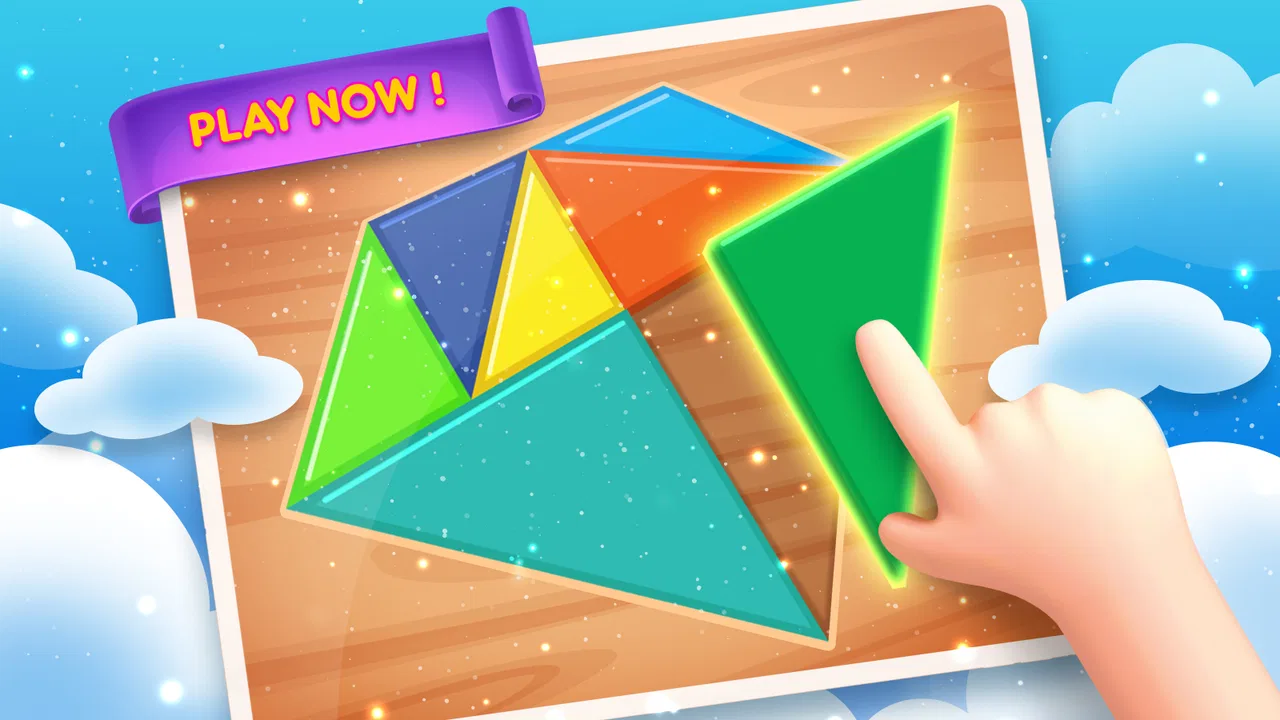
I found Tangram Heaven appealing for a simple reason: it turns a familiar puzzle idea into something I can pick up without preparation. The game is built around arranging geometric pieces into a complete shape, so the first action is immediately understandable. I choose a piece, move it toward the open design, and look for the angle and position that make the outline feel right. There is no long tutorial to study before the puzzle becomes playable.
That simplicity is the main attraction, but it is also what makes the game worth judging carefully. This is not a story-driven adventure or a competitive brain-training platform. It is a casual puzzle game from Gimica GmbH, designed for short periods of concentration. I see it working particularly well when I want a quiet activity between errands, during a commute, or at the end of the day when a more demanding game feels like too much effort.
The store summary calls it a puzzle experience for your pocket, while the short description presents it as tangram-focused. That description is accurate in spirit, but my interest comes from how the individual actions connect: place a piece, receive visual confirmation, complete a shape, enjoy the small sense of order, then begin again. The loop is uncomplicated, yet it gives each solved design a clear stopping point and a reason to try another.
You May Also Like

 Blood Strike: 2.5 Anniversary
Blood Strike’s Loadouts Turn Every Drop Into a Tactical Gamble
A close look at Blood Strike’s custom loadouts: how fast access to signature weapons reshapes its battle royale rhythm, rewards preparation, and narrows the gap between fights.

 Pandora - Music & Podcasts
Pandora’s Music Is Easy to Start, but Harder to Recover
Pandora’s strength is its low-effort path from a seed to a station. Its weak spot is how much confidence it asks you to place in connection, setup, and quiet recovery.

 8 Ball Pool
 Is Built on Rivalries, Rematches, and Routine
A close look at the rivalries, rematches, shared routines, and unanswered safety questions that turn a quick pool match into a persistent mobile community.

 Samsung Music
’s Quiet Strength Is Playing What You Already Own
Its reach comes less from spectacle than from dependable access to a personal library. That simplicity is both the app’s strongest retention engine and its ceiling.

 AccuWeather: Weather Radar
AccuWeather Review: A Quick, Clear Forecast for Everyday Decisions
For everyday plans, the best forecast is the one you can understand quickly. AccuWeather makes rain timing, radar, and local conditions easy to act on, with a few trade-offs.

 Hill Climb Racing
Why Hill Climb Racing Still Turns Crashes Into One More Run
A tiny car, a bumpy hill and one more upgrade: Hill Climb Racing keeps resurfacing because its simple chaos makes every near-miss feel personal.
More From Our News Desk



How the puzzle loop feels in actual play
I focus on the small decisions that make a session smoother: reading the outline before moving pieces, using distinctive edges as anchors, and treating a failed placement as a clue rather than a setback. That approach helps me avoid getting locked into a plausible but incorrect arrangement. Next, I look at how the game’s current version fits into its broader history and what that means for people returning to it.
The first move is easy, but not entirely mindless
The opening interaction is familiar even if you have never played this particular title. A collection of angular pieces must be fitted into a target form. I start by scanning the silhouette rather than dragging pieces randomly. Broad edges usually give me a useful starting point, while small triangular gaps are better left until the overall structure is clearer.
That small change in approach makes a noticeable difference. If I begin with the most visually distinctive piece, I can often identify where its shape belongs, but placing it too early may hide the relationships between the remaining pieces. When I instead inspect the empty outline first, I make fewer unnecessary moves. The game rewards observation before action, which is a good fit for anyone who enjoys puzzles that are calm but still require spatial judgement.
The controls are most comfortable when I treat every piece as part of a larger pattern rather than as an isolated object. I look for matching angles, straight borders, and areas where two pieces could create a clean internal line. This method is more satisfying than simply testing every possible position because the solution begins to feel reasoned rather than accidental.
That said, tangram puzzles can be demanding in a particular way. The rules are simple, but a nearly correct placement can still look convincing for a while. I sometimes find myself focusing on one stubborn area when the real problem is a piece placed incorrectly elsewhere. The useful habit is to step back after several failed attempts, reconsider the full outline, and undo the assumption that seemed obvious a moment earlier.
Feedback keeps each placement meaningful
The best part of the core loop is the steady feedback after each action. A piece either contributes to the picture or clearly fails to settle into the intended arrangement. That response helps me adjust without needing a complicated explanation. I can test an idea, see whether it improves the composition, and continue refining the design.
This creates a pleasant rhythm: inspect, move, compare, correct. The rhythm is slower than a reflex game, but it is not passive. My attention stays on the relationship between the pieces and the outline. A successful placement gives me enough confidence to continue, while an awkward one tells me to reconsider the angle, location, or order of assembly.
One useful technique is to use the outside boundary as an anchor. When a piece appears to form part of the silhouette, I try to secure that relationship before worrying about the interior. Another is to reserve unusually sharp or narrow pieces for spaces that visibly demand them. These are small habits, but they reduce aimless experimentation and make the solving process feel more deliberate.
I also like that the feedback does not need to be dramatic to be effective. A quiet puzzle benefits from restraint. The satisfaction comes from seeing the shape become coherent, not from a loud interruption after every move. For me, that makes it easier to stay focused during a short break without feeling as if the game is competing with everything else around me.
The reward is completion, not pressure
Finishing a design provides the central reward: the scattered pieces become a recognizable whole. That moment is modest, but it lands because I have watched the image emerge through my own decisions. The reward is less about collecting something elaborate and more about closing a visual problem cleanly.
This matters for the audience the game seems to target. Someone who wants a relaxing activity may not want timers, opponents, or a complicated progression system demanding constant attention. Here, the appeal is the successful transformation from disorder to structure. I can stop after a completed puzzle and feel that the session had a clear result.
It is also a useful choice for shared, low-pressure play. I can imagine handing the device to a family member and solving a design together, with one person suggesting a location while the other handles the pieces. The Everyone content rating supports that broad accessibility, although younger players may still need patience when a shape becomes difficult. The game is simple to understand, but simple rules do not guarantee simple solutions.
The free price makes trying it straightforward. There are in-app purchases ranging from ninety-nine cents to three dollars and forty-nine cents per item, so I would approach the optional spending with a clear personal limit. For a casual puzzle game, the important question is whether the free experience already gives enough satisfying solving time. If you dislike any purchase prompts or prefer a completely fixed-cost product, a paid puzzle with one upfront payment may feel cleaner.
Why another session begins
The reset after a completed design is what keeps the game moving. Once the shape is solved, the tension disappears, but the next puzzle offers a fresh arrangement and a new visual problem. I do not need to remember a plot, maintain a character, or prepare a strategy for another player. I simply return to the same basic action with a different challenge.
That reset is particularly effective for short sessions. I can play one puzzle while waiting for an appointment, stop when it is finished, and come back later without feeling that I abandoned an important task. The game suits fragmented time better than many larger puzzle titles that expect a long uninterrupted run.
There is a trade-off here. The same consistency that makes the game easy to revisit may feel repetitive if you need constant novelty. Players who prefer word puzzles, logic grids, match-based systems, or physics experiments may eventually want more variety in the underlying rules. Tangram Heaven stays focused on shape placement, so its strength is also its boundary.
My advice is to use it as a reset activity rather than as an all-day challenge. I get more enjoyment when I play until my attention starts to soften, then stop after a natural completion. If I push through while tired, the careful visual reasoning becomes less enjoyable and the puzzle can start to feel like work.
What makes it different from usual puzzle alternatives
Compared with match-three games, this title asks for spatial construction instead of quick pattern recognition. There is no need to chase chains or react to a changing board. Compared with word games, it relies less on vocabulary and more on visual rotation, proportion, and edge matching. Compared with Sudoku-style puzzles, it offers a more concrete result: I can see the finished object take form instead of filling a grid with abstract values.
Those differences help identify the right player. If you enjoy arranging furniture in a room, fitting objects into a bag, completing silhouettes, or spotting how shapes relate, the tangram format should feel intuitive. If you want a constant stream of surprises, fast scoring, or a strong competitive layer, another category will probably serve you better.
I would also distinguish it from elaborate mobile puzzle games that wrap each challenge in a narrative campaign. Those games may provide more motivation between levels, but they also demand more attention to menus, characters, resources, and progression. Tangram Heaven is more direct. I open it for the puzzle itself, not for everything surrounding the puzzle.
That directness can be a real advantage on a phone. The game is listed as free and supports devices using Android 7.0 or later, which makes it accessible to people who are not using the newest hardware. I still recommend checking how comfortably your particular screen handles dragging and rotating pieces, especially if you prefer playing on a smaller phone. Spatial puzzles benefit from enough room to inspect the outline without covering it with your finger.
Small techniques that improve solving
My first practical tip is to separate certainty from possibility. When a piece appears to fit, I ask whether its edges actually agree with the target or whether it merely occupies the right general area. This prevents a plausible early placement from controlling the rest of the solution.
My second tip is to build around distinctive constraints. A long straight side, a very sharp corner, or a narrow point usually has fewer possible destinations than a broad central area. I use those features as evidence. Once one or two constrained pieces are placed, the remaining open spaces become easier to interpret.
A third useful habit is to change scale mentally. Instead of asking where one piece belongs, I compare groups of pieces with sections of the silhouette. Sometimes the correct answer becomes clearer when I imagine two pieces forming a larger block. This is especially helpful when several individual pieces have similar angles.
Finally, I avoid treating a failed attempt as wasted time. A wrong placement can still reveal which area is too crowded or which edge cannot be part of the outside border. The game’s feedback becomes more valuable when I use mistakes as information rather than immediately repeating the same move in another position.
Where the experience may frustrate
The calm design does not remove all friction. Tangram solving can become visually stubborn when several pieces seem almost interchangeable. A player who expects every move to produce obvious progress may become impatient, particularly when the remaining gap is small but difficult to interpret.
There is also a difference between relaxing difficulty and effortless play. I would not describe every session as passive. Some puzzles require sustained attention, and the absence of a complicated rule system does not mean the answer is always immediate. That is positive for people who want a gentle mental workout, but less suitable for anyone seeking a game they can play while barely looking at the screen.
The purchase range is another consideration. The game costs nothing to start, but optional items can change how comfortable the experience feels for players who prefer not to spend. I recommend deciding in advance whether you are willing to make small purchases. This keeps the focus on solving instead of turning each session into a question about whether an extra item is worth buying.
Because the game is centered on one recognizable puzzle format, long-term appeal will depend on how much you enjoy that format. I can return to it repeatedly when I am in the mood for visual arrangement, but I would not install it as my only puzzle game. A broader puzzle collection is a better choice if you need daily variety or regularly switch between different kinds of mental challenge.
Who should install it
I would recommend it to casual players who want a clear beginning and ending to each activity. It is also a good match for people who enjoy visual reasoning but do not want a timer or an opponent setting the pace. Families can use it as a cooperative screen activity, and adults may appreciate it as a quiet alternative to scrolling through social feeds.
The Everyone rating makes it suitable for a broad audience, though the actual enjoyment will depend on patience and comfort with spatial puzzles. Someone who likes assembling forms piece by piece will probably understand the appeal quickly. Someone who finds rotating and comparing shapes tiring may not get much from repeated sessions, even if the controls are easy to grasp.
I would skip it if your priority is a deep story, character progression, online competition, or a constantly changing ruleset. I would also look elsewhere if you want a puzzle game with a single upfront purchase and no optional spending. Tangram Heaven is at its best when you value the solving moment itself and are happy to return to a focused, familiar loop.
Device expectations and everyday use
The Android requirement begins with version 7.0, so the game is not limited to recent phones. In daily use, I would still give it a comfortable screen and enough uninterrupted attention to see the shape clearly. A cramped display can make a simple drag feel less precise, especially when several pieces overlap visually.
A realistic scenario for me would be playing after lunch during a short break. I open the game, spend a moment identifying the strongest outer edge, place a few pieces, and finish or pause at a natural point. If the puzzle resists, I do not need to commit to a long campaign; I can leave and return when my mind is fresher. That flexibility is more valuable than it sounds because it keeps the game from becoming another obligation.
The current version is 1.6.2, and the title has already passed one million installs. Its average rating is 4.2 from roughly two thousand four hundred ratings, with hundreds of written reviews. Those figures suggest that the basic concept connects with a substantial audience, but they should not replace personal fit. A popular tangram game can still be wrong for a player who needs variety or fast action.
My verdict on the complete loop
The loop works because every stage has a clear purpose. I take an action by selecting and positioning a geometric piece. I receive feedback from how well that piece contributes to the target. I earn a visual reward when the design is complete. Then the puzzle resets into a new arrangement, giving me a reason to begin another session without adding unnecessary complexity.
That structure makes Tangram Heaven a dependable casual puzzle rather than an ambitious all-purpose game. I like its focus, its low-pressure pace, and the way a completed shape provides a satisfying stopping point. The strongest sessions are the ones where I slow down, use the outline as evidence, and let each mistake narrow the possibilities.
My recommendation is positive with a clear condition: install it if you genuinely enjoy fitting shapes together and want a free game for calm, repeatable sessions. Keep your expectations realistic about variety and optional purchases, and do not expect a narrative or competitive experience to develop around the puzzles. For the right player, the simplicity is not a weakness. It is the reason one solved design can make a short break feel complete, while the next empty outline quietly invites another attempt.
FAQs for Tangram Heaven
01What is Tangram Heaven and how does it work?
Tangram Heaven is a puzzle app that brings the classic Chinese tangram game to your mobile device. The app features a variety of geometric puzzles where players use seven flat pieces to form a specific shape. It offers multiple levels of difficulty, ensuring both beginners and seasoned tangram enthusiasts find it engaging.
02Is Tangram Heaven suitable for children?
Yes, Tangram Heaven is suitable for children. The app is designed to be educational and entertaining, helping improve spatial awareness and problem-solving skills. With its colorful interface and varying levels of difficulty, it is perfect for kids who enjoy puzzles. Parents can adjust settings to match their child's skill level.
03Does Tangram Heaven require an internet connection?
Tangram Heaven can be enjoyed offline, making it perfect for travel or situations where internet access is limited. However, certain features, such as leaderboard updates and new puzzle downloads, might require an internet connection. This flexibility ensures you can play anytime, anywhere.
04Are there in-app purchases in Tangram Heaven?
Tangram Heaven offers in-app purchases. While the initial download provides a substantial number of puzzles for free, users can purchase additional puzzle packs and remove ads through one-time payments. These options enhance the gaming experience but are not required to enjoy the game.
05How frequently does Tangram Heaven receive updates?
Tangram Heaven is regularly updated to ensure optimal performance and user satisfaction. Updates typically include new puzzle packs, bug fixes, and enhancements to gameplay mechanics. The developers are committed to maintaining a fresh and engaging experience for all users.
Pros
- Intuitive interface for easy gameplay.
- Multiple levels with increasing difficulty.
- Visually appealing graphics and design.
- Encourages creative problem-solving skills.
- Regular updates with new puzzles.
Cons
- Limited hints available for challenging puzzles.
- Ads can be intrusive during gameplay.
- No multiplayer or social sharing features.
- Requires internet connection for some features.
- Lack of customization options for themes.

Tangram Heaven
Gallery